I always wanted to write about this.
There's an irony that shows up every time someone proposes something that breaks with what's established: the one who knows the most looks the most unsure, and the one who knows the least looks the most confident.
Two syndromes pushing opposite ways
Impostor syndrome is well known: the more you learn, the more aware you are of everything you're missing, so you doubt. The one who really knows carries that doubt around.
On the other side is the Dunning-Kruger effect: the one who knows little doesn't know enough to realize what they don't know, and that ignorance gives them confidence.
Put the two together and there's your problem. In a room, confidence reads as competence. The one who doubts loses to the one who doesn't, even though they often doubt precisely because they know more. We reward the wrong person without noticing. And that's why credibility got so scarce: it's hard to tell the one who actually knows from the one who only looks like it.
When you propose something different
You propose something different and the first thing you get is resistance. And that resistance pushes you to lower your hand and keep the idea to yourself.
It happens almost everywhere. New things move the status quo, and moving the status quo is costly. It's more comfortable to leave things as they are, so a different idea often gets met with suspicion before curiosity.
That's why a lot of people end up quiet. They have good ideas, but stepping out of the mold is daunting and it's easier to not make noise.
And that's where building in public changes the game: instead of keeping your work to yourself, you put it out into the world. Some won't see the value. Plenty of others will, and those are the ones who matter.
Building today is a different thing
Getting something of your own off the ground has never been as cheap or as accessible as now.
Here's a real example: this blog. It has a backend with an API, frontend, captcha, a database, email subscriptions, reactions. A real system. How much does it cost me a month? Zero. Free infrastructure, with its limits of course, but more than enough to build something worthwhile.
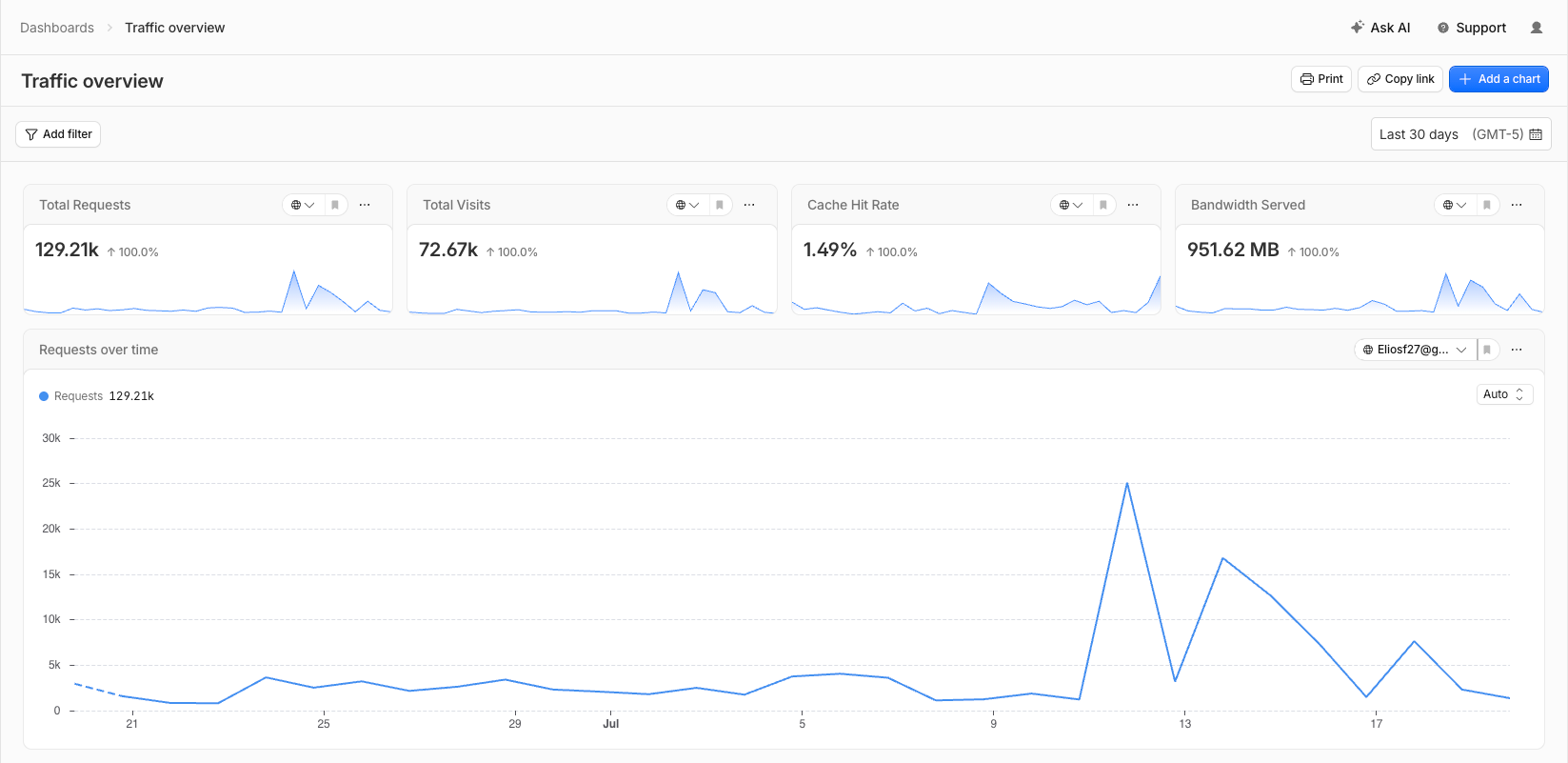
In the last 30 days it moved around 129 thousand requests and served close to 950 MB, all within that zero. They're requests, not unique readers: reloads, bots and crawlers all count. Even so, it's alive and running without costing me anything.
And with AI you move even faster: things that used to need a team, today you can do yourself. And on top of that, it's fun again.
Careful though, not everything fits in zero. Something that has to scale for real, like Frauddi, needs something more powerful and scalable, like AWS or Google Cloud.
For anyone who wants to dig in: nobody pays me to say this. There are several options, like Cloudflare, AWS, Substack or GitHub Pages. I'm just sharing what worked for me.
It's the moment for the one who wants to learn
The person who likes to learn and starts trying things on their own is the one who gets the most out of this.
The tools are already there, free or almost. Access stopped being the problem.
And building, you run into real problems you have to solve, and that's where you really learn. Just go for it.